
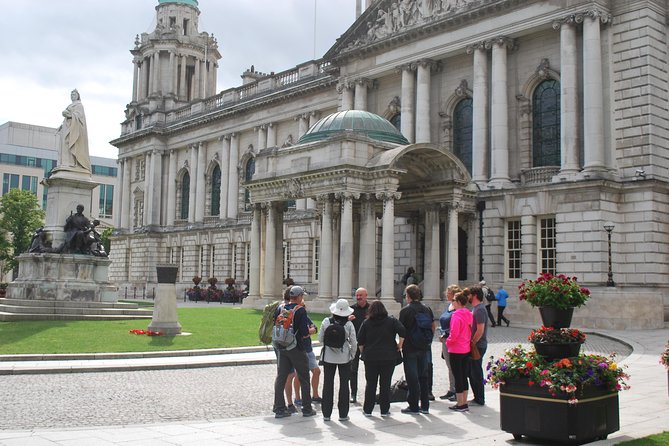
Reviewed · HISTORICAL TOURS
A History of Terror – Belfast City Centre Walking Tour
Belfast’s streets carry difficult stories. This 2.5-hour walking tour connects the city centre to the events of The Troubles, moving from City Hall through the Cathedral Quarter to the River Lagan. You hear about politics, violence, policing, peace, and daily life from guides such as James, Anne, Mylie, and Róisín.
I like the balanced presentation and the way the tour links major events to ordinary streets. I also like the use of headsets, which matters in a group of up to 25 people. The main drawback is that this is often more standing and listening than walking, and the subject can be genuinely sad.
This is an excellent choice if you want to understand Belfast before exploring its murals, museums, or former conflict sites on your own. It is less suitable if you want a light sightseeing walk or a tour focused mainly on architecture.
In This Review
- Key points to know before you book
- Why this Belfast walking tour matters
- City Hall sets the political scene
- Donegall Place and the Ring of Steel
- Castle Lane reveals everyday fear
- The Spirit of Belfast and the spark of escalation
- The Cathedral Quarter connects past and present
- Ann Street explains policing and the border question
- The Beacon of Hope offers a careful ending
- Price, group size, and practical comfort
- Who will get the most from this tour?
- Should you book A History of Terror?
- FAQ
- Where does the Belfast walking tour start?
- What time does the tour begin?
- How long is the tour?
- How far do you walk?
- Where does the tour finish?
- Is the tour suitable for children?
Key points to know before you book
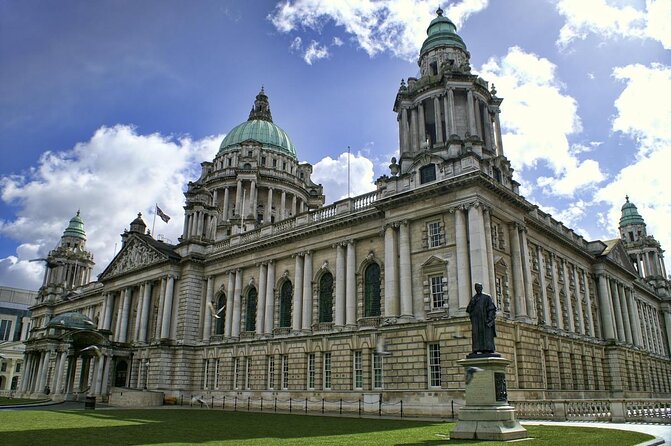
- Personal accounts make the history feel immediate: Several guides, including Anne and Róisín, grew up during The Troubles and can explain how the period affected everyday life.
- The route covers about 1.5 miles: Belfast city centre is flat, with no hills or steps on the walk.
- The tour is deliberately balanced: The guide explains British and Irish relationships, unionist and nationalist viewpoints, the causes of violence, and the road to peace.
- You visit places linked to bombings and deaths: This is a serious history tour, not a spooky entertainment walk.
- The Cathedral Quarter gives the route a modern contrast: Street art, bars, and regenerated lanes sit beside stories from the worst years of the conflict.
- The ending is hopeful but not simplistic: At the Beacon of Hope, the guide discusses the peace agreement, Belfast today, and the uncertainty around Northern Ireland’s future.
Why this Belfast walking tour matters
Belfast is easy to enjoy at street level. You can shop on Donegall Place, have a drink in the Cathedral Quarter, and walk beside the River Lagan without seeing much evidence of the city’s recent past. That is exactly why this tour is useful. It helps you understand what happened beneath the ordinary modern surface.
The tour begins at Belfast City Hall at 10:30 in the morning. From there, your guide explains the long relationship between Britain and Ireland before moving into the events that led to The Troubles in the late 1960s. This opening is important because the conflict did not appear from nowhere, and a short explanation of the older political and religious divisions gives the later stops a clearer shape.
I appreciate that the tour does not treat The Troubles as a simple story of good people against bad people. Guides explain the competing identities and political aims, then show how fear, discrimination, retaliation, and armed groups pushed Northern Ireland into decades of violence.
The tour has a maximum of 25 people. That is not a tiny group, but the headsets help you hear the guide while standing on busy city streets. One poor experience was caused by a faulty speaker and a guide who did not adjust well when people at the back could no longer hear. This seems to be an occasional equipment problem rather than the normal experience, but it is worth staying close to the guide.
More City Tours in Belfast
- Private Black Taxi Belfast City Tour
★ 5.0 · 2,188 reviews - City Sightseeing Belfast Hop-On Hop-Off Bus Tour
★ 4.5 · 2,012 reviews - Belfast Eclectic Walking City Center Experience, The Marti Way
★ 5.0 · 348 reviews
City Hall sets the political scene
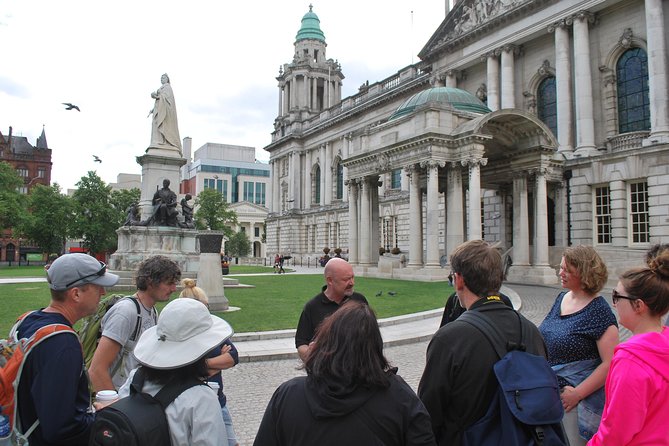
The grounds of Belfast City Hall provide a calm start for difficult material. Your guide introduces the tour here and explains the background to the conflict, including the centuries-old tension between British and Irish political identities.
This first section lasts about 20 minutes. You are not simply looking at a civic building while someone recites dates. The point is to understand why Belfast became such an important centre of political struggle and why the city’s divided loyalties mattered so much.
I would pay close attention here, even if you already know the broad outline of Irish history. The guide’s framing helps separate the older political dispute from the later violence of The Troubles. It also prepares you for the neutral tone used throughout the walk.
The city-centre setting makes the opening especially effective. Belfast City Hall is a familiar public landmark, yet the discussion quickly shows that public places can hold several competing memories.
Donegall Place and the Ring of Steel
The walk continues to Donegall Place, now one of Belfast’s main shopping streets. It looks like a normal commercial thoroughfare, which makes the account of a 1971 nightclub bombing especially stark.
Your guide explains the attack, the tragic events that followed, and the introduction of the security measures known as the Ring of Steel. The stop lasts around 15 minutes, and it shows how violence changed the basic experience of moving through central Belfast.
This is one of the tour’s strongest ideas: familiar streets are not empty backdrops. Shops, pavements, and public buildings were part of daily life during the conflict, and people had to adjust to checks, barriers, fear, and sudden danger.
You should expect the guide to discuss deaths and loss directly. The presentation is serious rather than sensational. If you prefer only cheerful sightseeing, this stop may feel heavy, but that weight is part of the value.
Castle Lane reveals everyday fear
At Castle Lane, the tour moves into a pedestrian shopping area. Today, you might think mainly about cafés, shops, and foot traffic. The guide instead explains what it was like to live in Belfast at the height of The Troubles and describes an event that remains strongly remembered.
The stop takes about 15 minutes. It is another example of the tour’s method: the guide places a major event in an ordinary location, then explains how the incident affected people beyond the headlines.
I find this approach more useful than a list of dates. You begin to picture how a bombing or shooting could alter a street, a business, or a family’s routine. The walk also makes clear that the conflict was not confined to distant borders or military sites. It entered the centre of everyday life.
Since there are several stops with extended explanations, you may spend more time listening than walking. Wear comfortable shoes, but do not expect a brisk hike.
More History Tours in Belfast
- Belfast: A History of Terror Walking Tour
★ 4.9 · 854 reviews - Private Political History & Murals Tour Belfast
★ 5.0 · 182 reviews - Belfast: Best of Belfast History, Culture & Art Walking Tour
★ 4.9 · 158 reviews - Belfast Walking Tour with a Local – History & Craic
★ 4.9 · 130 reviews
The Spirit of Belfast and the spark of escalation
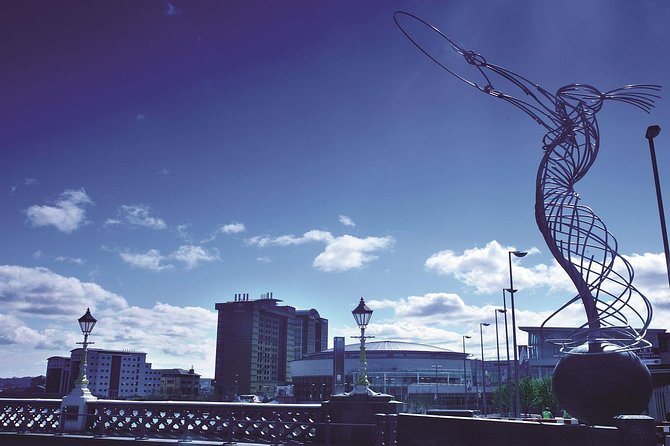
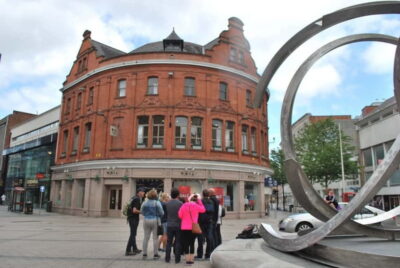
The next stop is the Spirit of Belfast, a public artwork that many locals call the Onion Rings. The sculpture is meant to suggest resilience, but here it becomes a place to discuss events that began in a nearby bar in 1971.
Your guide explains how those events helped push Northern Ireland into a rapidly worsening cycle of violence. The contrast is striking. You are beside a modern piece of public art in a redeveloped city, listening to how a nearby incident helped shape years of fear and conflict.
This is where the tour moves from broad background to the chain reaction of specific events. The guide shows how individual incidents could produce retaliation, new security measures, and deeper division.
The public artwork also introduces a theme that returns at the end: Belfast has changed, but the past has not vanished. Regeneration can improve streets and create new meeting places, yet it does not erase the memories attached to them.
The Cathedral Quarter connects past and present
The Cathedral Quarter is probably the most visually lively part of the walk. Its lanes contain street art, bars, and nightlife, and the area has become one of Belfast’s cultural centres. The guide uses this modern setting to explain further events from The Troubles and the early steps toward peace.
This section lasts about 20 minutes. It is a useful pause in the route because you can see the city’s present life while learning about its recent past. The contrast is not forced. It helps you understand how much Belfast has changed since the 1970s.
The storytelling is a major strength here. James has been praised for making the political material clear and engaging, while Mylie has been singled out for combining strong subject knowledge with an easy personal manner. Róisín is also noted for bringing emotion to stories she experienced firsthand.
You should not assume that every guide delivers the tour in exactly the same way. The names most often associated with strong tours include James, Anne, Mylie, Róisín, Jim, Chris, and Rorey. Some focus more on personal memories, while others concentrate on political context. The shared aim is a neutral account that lets you form your own view.
Ann Street explains policing and the border question
At Ann Street, you stand beside Belfast’s largest police station and learn how Northern Ireland was policed during The Troubles. The guide then explains how policing changed after the peace agreement.
This 15-minute stop gives the tour an important institutional angle. Earlier sections focus on bombings, victims, and community fear. Here, you learn about the forces responsible for security and how their role changed as the conflict moved toward peace.
The discussion also reaches Brexit and the possible impact on borders. That makes this stop feel current rather than locked in the past. Northern Ireland’s political questions did not disappear when the violence declined, and the guide connects old divisions with modern uncertainty.
For me, this is one of the clearest reasons to take the walk early in your Belfast visit. It provides context for conversations about identity, the border, policing, and the relationship between Northern Ireland, Ireland, and Britain.
The Beacon of Hope offers a careful ending
The route finishes at the Beacon of Hope beside the River Lagan. The artwork celebrates resilience and regeneration, and it gives the guide a fitting place to compare Belfast today with one of the darkest periods in its history.
The final talk lasts about 20 minutes. You hear how the peace was achieved, why it remains fragile, and what the future might hold. The ending is hopeful, but it does not pretend that every political or social question has been settled.
I like that the tour finishes by the waterfront rather than returning to the starting point. The city centre has gradually changed during the walk, and the riverfront offers space to think about that change. From the Beacon of Hope, you are about five minutes from City Hall on foot, so returning to your starting area is simple.
This is not a triumphant finale with all problems neatly solved. The guide leaves you with a more honest view: violence has declined, public life has improved, and peace exists, but memory and politics still matter.
Price, group size, and practical comfort
The cost is about $36.06 per person. For a 2.5-hour guided walk, that is fair value, particularly because the tour covers several major themes and includes a local guide plus headsets.
The value depends on what you want from Belfast. If you only want to see landmarks, you can walk much of the route for free. You are paying here for context, personal accounts, and the ability to ask questions while the places are directly in front of you.
The walk covers roughly 1.5 miles through flat central streets. There are no hills or steps, and most people can take part, but the tour involves repeated periods of standing. Comfortable footwear is still wise.
The tour runs in English and uses a mobile ticket. It goes ahead in the weather, so bring a waterproof jacket for showers and warm clothes in winter. The weather can make a serious walk feel harder, especially when you are standing still for long explanations.
The minimum age is 12. Service animals are allowed, and the starting and ending points are close to public transport. The group limit of 25 keeps the price reasonable, though you should stay near the guide if you want the clearest sound and best view.
You can cancel for a full refund up to 24 hours before the start time. Cancellations or changes made inside that period are not refunded, and poor weather may lead to another date or a full refund.
Who will get the most from this tour?
I would choose this tour if you are visiting Belfast for the first time and want a solid foundation before exploring further. It suits anyone interested in modern European politics, local memory, peacebuilding, or the personal effects of conflict.
It is also a good fit for people who value firsthand stories. Anne, Róisín, and other guides have described growing up during the period, while other guides bring strong historical and political preparation. Those personal details help the material feel human without turning the walk into a one-sided account.
The tour may suit older children from age 12, provided they are ready for serious discussions of bombings, deaths, and political violence. I would not book it for a child expecting entertainment or a typical city highlights walk.
You should also consider your preferred learning style. If you enjoy stopping, listening, and asking questions, the pace works well. If you want constant movement and lots of interior visits, you may find the long talks slow.
The tour has earned a 5 out of 5 rating from 2,882 ratings, with 99 percent of participants recommending it. That level of approval fits the strongest pattern: guides are praised for clear explanations, personal warmth, careful balance, and the ability to make 2.5 hours pass quickly.
Should you book A History of Terror?
Yes, if you want to understand Belfast rather than simply photograph it. The route is easy, the price is reasonable, and the best guides turn difficult political history into a clear human story.
Book it near the start of your stay so the rest of Belfast makes more sense. Keep your expectations realistic: you will stand in the rain if the weather turns, some stories are painful, and a faulty headset can affect the experience. Still, with a good guide such as James, Anne, Mylie, or Róisín, this is one of the most useful ways to meet Belfast’s past and its cautious hope for the future.
FAQ
Where does the Belfast walking tour start?
The tour starts in the grounds of Belfast City Hall at Donegall Square North, Belfast BT1 5GS.
What time does the tour begin?
The scheduled start time is 10:30 am.
How long is the tour?
The tour lasts about 2 hours and 30 minutes.
How far do you walk?
You walk approximately 1.5 miles through Belfast city centre. The city centre is flat, with no hills or steps on the route.
Where does the tour finish?
The tour ends at the Beacon of Hope on Oxford Street, Belfast BT1 3NB. From there, it is about a five-minute walk back to City Hall.
Is the tour suitable for children?
The minimum age is 12. The tour discusses The Troubles, including bombings, deaths, politics, and violence, so younger participants should be prepared for serious subject matter.
More Walking Tours in Belfast
- Belfast: Political Conflict 3-Hour Walking Tour
★ 4.6 · 2,215 reviews - Belfast: The Troubles Walls & Bridges Guided Walking Tour
★ 4.8 · 583 reviews - Belfast Political Tour-Conflicting Stories Walking Tour
★ 4.5 · 459 reviews - Best of Belfast Walking Tour
★ 5.0 · 399 reviews
Newest reviews from Belfast
- VIP Skip-the Line Titanic Museum and Whiskey Tasting Tour★ 4.8 · 11 reviews
- Giants Causeway Private Tour★ 5.0 · 3 reviews
- Titanic Eastside Bike Tour★ 5.0 · 9 reviews
- Private Half Day Winter Magic in the Antrim Glens★ 5.0 · 2 reviews
- The Single Cask Whiskey Experience★ 5.0 · 6 reviews
- This is Belfast Walking Tours. Our history, our culture.★ 5.0 · 7 reviews
- St Patrick’s Centre & Burial Site + Hillsborough Castle & Gardens★ 5.0 · 2 reviews
- Shore Excursion from Belfast to Giants Causeway & Rope Bridge★ 5.0 · 2 reviews
Historical Tours, compared.
McCrossan’s Public Walking Tour of the Historic City
Read our review →
Private Political History & Murals Tour Belfast
Read our review →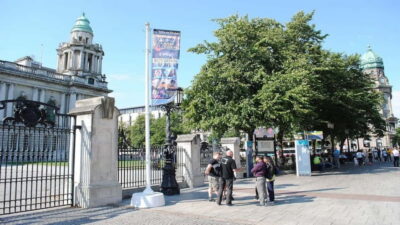
Best of Belfast History, Culture & Art Walking Tour
Read our review →
Belfast Walking Tour with a Local – History & Craic
Read our review →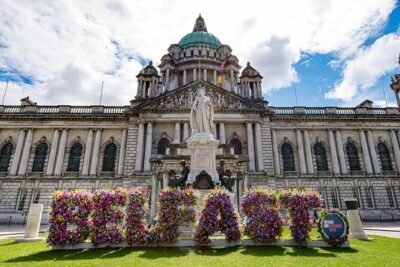
Belfast Political/history/troubles private taxi/cab tour
Read our review →
Peacewall and Political History Black Taxi Cab Tour
Read our review →Browse the lists this tour appears in