
Reviewed · MURALS & PEACE WALL TOURS
Belfast Troubles Tour: Walls and Bridges
Belfast’s walls tell only part of the story. This walking tour connects City Hall, the Peace Wall, murals, old passageways, and the Cathedral Quarter while explaining how politics, religion, industry, music, and daily life shaped the city. I especially like the local guide’s lived perspective and the way the tour covers both sides of Belfast’s divide. I also like that it finishes with a message about building bridges, not simply recounting old violence. The main consideration is that the subject matter can be graphic and emotionally heavy, and you will be walking for nearly three hours.
At $33.29 per person, this is a strong value if you want context rather than a quick collection of photo stops. Guides such as Arthur Magee and Steve have been praised for combining clear history, personal stories, humor, and a neutral tone. Bring comfortable shoes, an open mind, and enough attention for a serious conversation.
In This Review
- Key points to know before you book
- Why this Belfast walking tour is worth your time
- City Hall and the meaning of Belfast’s center
- Murals on Divis Street and the International Wall
- The Peace Wall and Belfast’s divided communities
- The Albert Clock and Belfast’s early foundations
- Cathedral Quarter, music, and old Belfast passages
- First Presbyterian Church and a less familiar story
- How the guide shapes the experience
- Price, pace, and practical value
- Who should take the Walls and Bridges tour?
- Should you book this Belfast Troubles tour?
- FAQ
- How long does the Belfast Troubles Tour last?
- Where does the tour begin?
- Where does the tour finish?
- What sights are included?
- Is the tour suitable for children?
- How much walking is involved?
- Is the tour private?
- What language is the tour offered in?
- Can I cancel for a refund?
Key points to know before you book
- Personal stories from Belfast guides: Arthur Magee and Steve explain the Troubles through local experience, not just dates and political labels.
- A true walking route: You cover City Hall, Divis Street murals, the Peace Wall, the Albert Clock, the Cathedral Quarter, Belfast Entries, and First Presbyterian Church.
- More than a Troubles tour: The route also looks at Belfast’s industry, architecture, music, religious freedom, politics, and future.
- Graphic content is included: This tour is intended for people aged 14 and older and is not designed for young children.
- Small private experience: The tour includes a local professional guide, with a maximum of 16 people.
- Easy city-center start and finish: Begin at Belfast City Hall and finish near Rosemary Street, within sight of where you started.
Why this Belfast walking tour is worth your time
The word Troubles can sound like a tidy label for a complicated period. In Belfast, it refers to decades of political conflict, religious division, discrimination, shootings, bombings, imprisonment, and loss. A tour of this subject needs more than a quick stop at a painted wall.
This experience gives you time to ask questions and connect the difficult events to the streets around you. The guides explain how Unionist and Nationalist communities developed, how British and Irish identities shaped politics, and how ordinary people lived through the conflict. The strongest praise has gone to the guides’ ability to stay balanced while still speaking with feeling.
I like that the tour does not treat Belfast as a museum of violence. You see the Peace Wall, but you also walk through the Cathedral Quarter, old city passages, a grand civic building, and a historic church. That wider view matters. Belfast is a working city with a past, not a single historical event frozen in place.
The tour lasts about two hours and 40 minutes to three hours. Some sessions have reportedly run longer when the guide stayed to answer questions, but you should plan on three hours. The route includes a fair amount of walking, so this is not the right pick if you want a seated introduction or a bus-based overview.
Other tours of the murals and peace walls:
- Belfast: Political Taxi Tour
★ 4.8 · 5,014 reviews - Belfast: Political Conflict 3-Hour Walking Tour
★ 4.6 · 2,215 reviews - Belfast: Murals Taxi Tour
★ 4.9 · 2,047 reviews
City Hall and the meaning of Belfast’s center
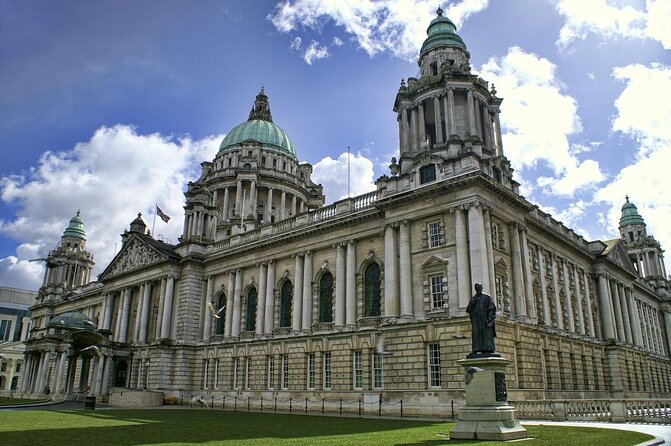
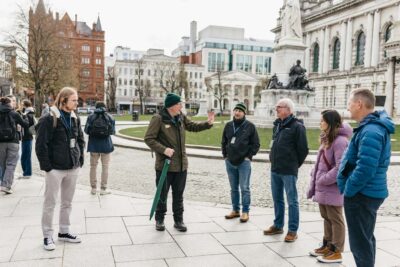
The tour begins at Belfast City Hall, one of the city’s most impressive buildings. Its dome reaches 174 feet, and the interior uses several types of marble, including Italian marble and Cippilino marble from Greece. Stained glass adds color and detail to a building designed to make a strong civic statement.
You have only about 10 minutes here, with no admission charge. That is enough for an introduction and a look at the exterior, though it is not a full architectural tour. If you want to study the interior carefully, you may need to return on your own.
Starting here is useful because City Hall gives you a sense of Belfast’s civic center before the route moves into the communities shaped by the Troubles. You begin with public architecture and official power, then gradually move toward streets where political identity was more personal and more contested.
The walk also includes the Big Fish and a modern sculpture by Dan George. The sculpture uses a Celtic design while reflecting Belfast’s engineering, industry, and communities. These early stops help place the conflict within a broader story about the city, rather than making every sight a symbol of division.
Murals on Divis Street and the International Wall
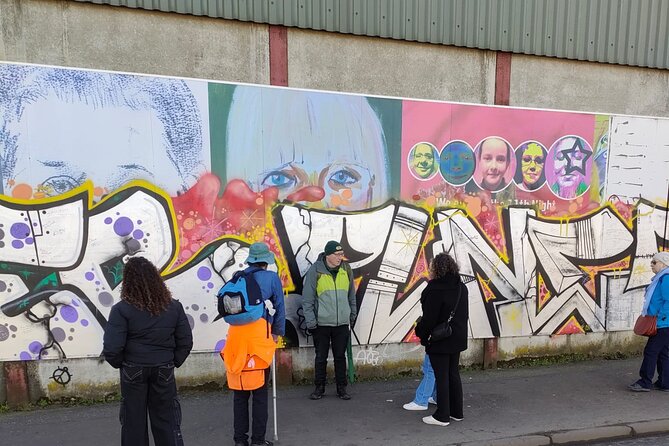
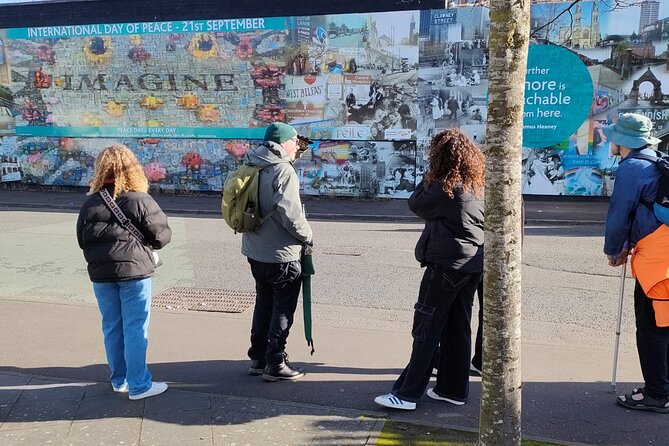
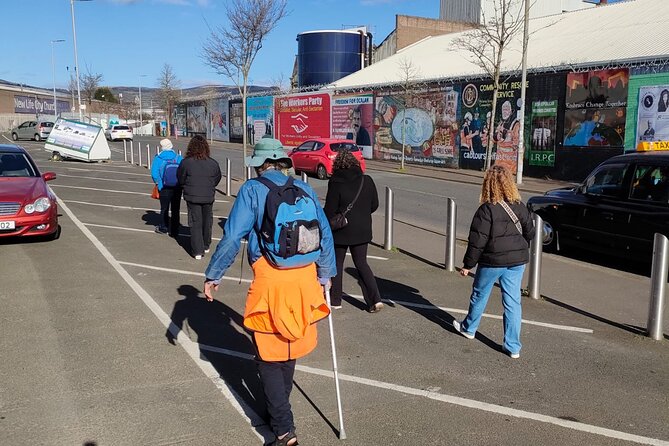
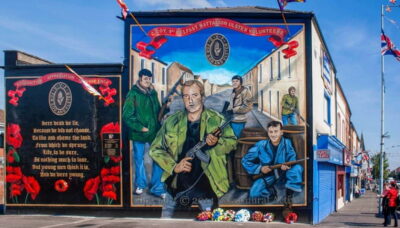
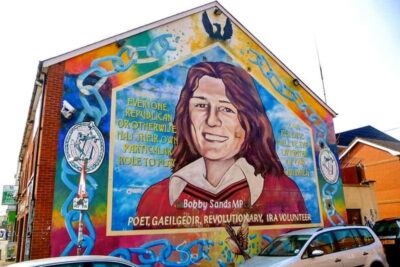
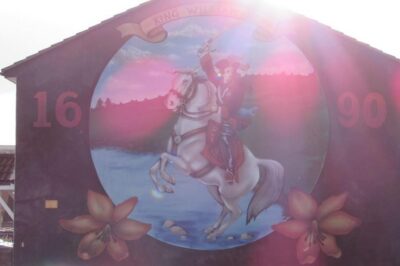
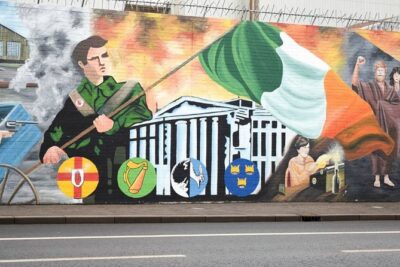
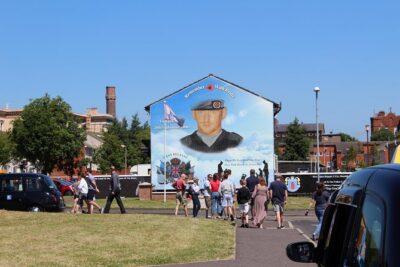
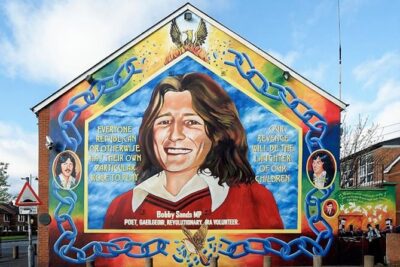
At the International Mural Wall on Divis Street, the guide explains how murals functioned as political communication. Near the Peace Walls, these paintings are not simply street art. They have been used as public media, expressing identity, memory, solidarity, and political positions.
You can expect about 10 minutes at the mural wall. That is enough time for photographs and an explanation, although the value depends heavily on the guide’s interpretation. A quick photograph without context can reduce these images to colorful backgrounds. The commentary is what helps you understand why murals appear so often in Belfast and why their messages matter.
The route’s strength is its use of place. Instead of discussing the conflict in an abstract room, you are standing beside the walls and images that continue to shape how communities present themselves. I would listen carefully here, especially if you know little about the difference between Unionist and Nationalist traditions.
The guide’s tone is important. The best version of this tour does not tell you which side to support. It gives you enough background to recognize the fears, loyalties, and prejudices that helped keep the conflict going.
The Peace Wall and Belfast’s divided communities
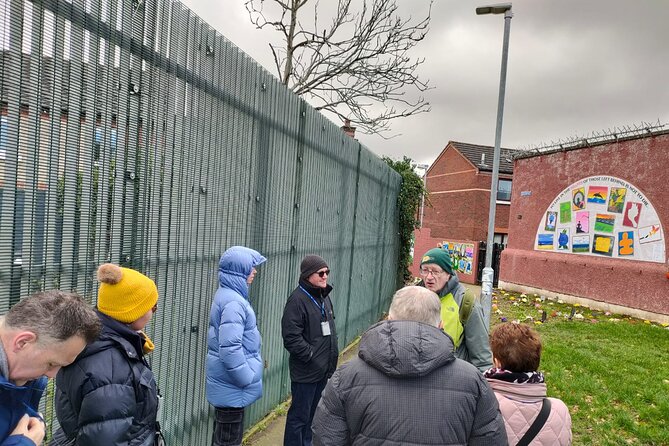
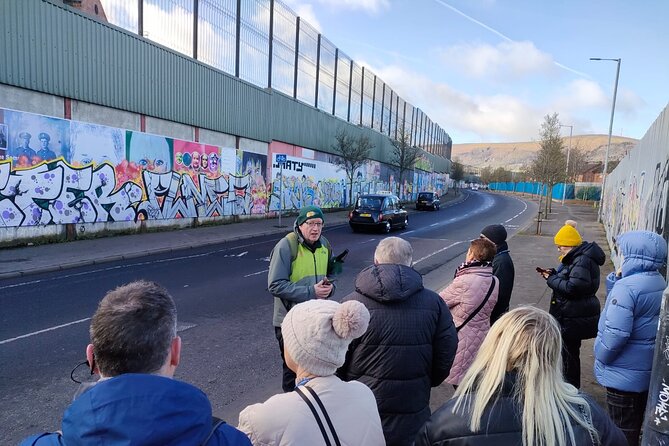
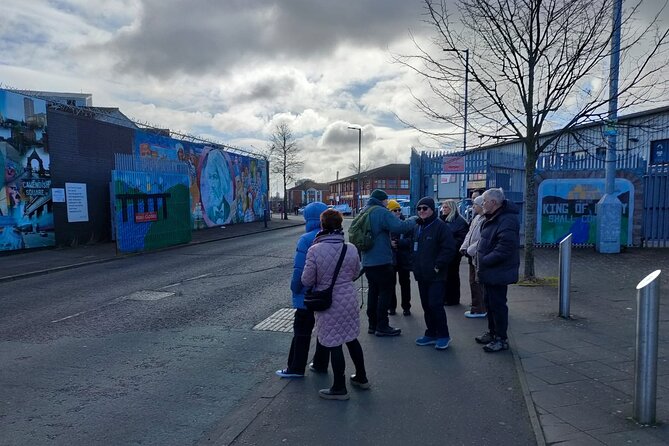
The Peace Wall is the emotional center of the tour. These barriers separate two communities and reach about 16 metres high. Mesh at the top was used to help stop petrol bombs from being thrown across the divide.
You have around 15 minutes here, with time to take photographs and examine the construction. More important, you have time to hear why such a wall exists and what it means to people who live near it. The physical scale is striking, but the human idea behind it is harder to absorb: a city can have peace while still keeping communities apart.
The name Walls and Bridges refers to more than concrete and metal. The walls are the divisions people build between one another. The bridges are the effort to understand neighbors instead of reducing them to labels. That theme gives the tour a clear purpose and keeps it from becoming a simple catalogue of grim events.
You should be prepared for difficult material. The tour includes graphic descriptions of violence, and several parts can feel raw or emotional. That honesty is useful for adults and older teenagers who want a serious account, but it may be too much for anyone seeking a light sightseeing walk.
More Belfast outings booked on the same trip:
- Belfast: The Titanic Experience with SS Nomadic Visit
★ 4.7 · 7,163 reviews - From Belfast: Giant’s Causeway and Game of Thrones Day Tour
★ 4.4 · 7,061 reviews - From Belfast: Giant’s Causeway Full-Day Guided Trip
★ 4.8 · 6,361 reviews - Titanic Belfast Entrance Ticket: Titanic Visitor Experience Including SS Nomadic
★ 4.5 · 3,698 reviews
The Albert Clock and Belfast’s early foundations
The Albert Memorial Clock Tower takes only about five minutes, but it provides a memorable visual stop. Belfast’s own leaning tower rises 113 feet, or about 24 metres, and leans roughly four feet from vertical. The clock was built at the spot connected with the crossing that helped establish Belfast as a town.
The tower includes a statue of Prince Albert and appeared in the film noir Odd Man Out, starring James Mason. These details offer a welcome change of pace after the Peace Wall. You are still learning about Belfast’s past, but now through architecture, film, and civic memory.
The clock is close enough to the route that it works well as a short stop rather than a major detour. Do not expect a long visit or an interior climb. Its value is in seeing the tower in context and hearing why it became one of Belfast’s familiar landmarks.
Cathedral Quarter, music, and old Belfast passages
The Cathedral Quarter presents another side of the city. This area has colorful murals, pubs, restaurants, cobbled streets, and old entries. It is now one of Belfast’s main cultural areas, but the tour also points to older stories, including major rock events connected with the district.
This 10-minute section gives the tour some breathing room. You move from barriers and political murals into a part of town associated with nightlife, music, and renewal. I like this contrast because it shows that Belfast’s identity is not only tied to conflict.
The Belfast Entries are historic passageways that are easy to miss if you do not know where to look. The guide leads you through them, pointing out places connected with revolution, intrigue, and pubs. These narrow routes offer a more intimate sense of old Belfast than a broad modern street can provide.
You will not spend long at each entry. The point is not to inspect every building but to notice the hidden routes that shaped movement through the city. This is one reason a walking guide can be more useful than a bus. A bus can show you the main roads, but it cannot take you into these small passages.
First Presbyterian Church and a less familiar story
First Presbyterian Church is the final major stop and one of the tour’s most distinctive features. Dating from 1783, it has an elliptical interior that impressed John Wesley, who preached from the pulpit. You have about 10 minutes to enter, look around, and take photographs.
The church complicates the usual story of Belfast as a city divided into two fixed religious camps. Its members made important stands for civil and religious freedoms, showing that religious identity, political belief, and personal values did not always fit into simple categories.
That is a valuable way to finish. After hearing about communities separated by religion and politics, you see a building connected with people who challenged restrictions and defended freedoms. It gives the tour a wider historical frame and avoids presenting the Troubles as an ancient or inevitable feud.
The church is also practical as an endpoint. It is on Rosemary Street, about five minutes from City Hall and within sight of where the walk began. You finish in the city center, close to public transport and other sights.
How the guide shapes the experience
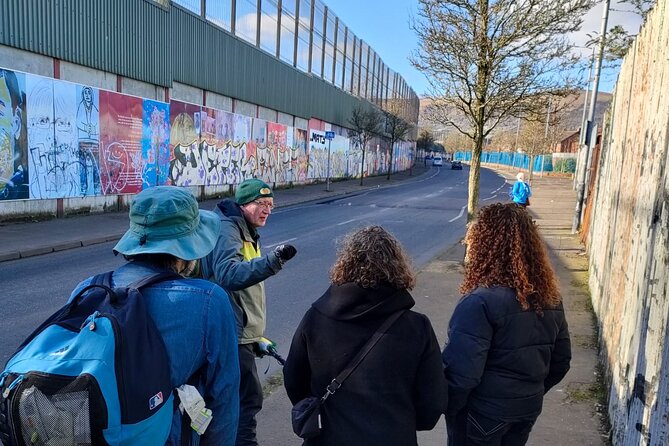
This is a guide-led tour in the fullest sense. The buildings and walls matter, but the explanations make the route worthwhile. Arthur Magee has received especially strong praise for his storytelling, humor, personal experience, and direct treatment of the Troubles. Steve has also been praised for informative commentary and personal stories from the period.
You should expect a mix of history, politics, economics, music, and social commentary. The best guides use humor to help you stay engaged, but they do not make light of the suffering. The balance can be difficult, and the tour’s appeal depends on your comfort with that tone.
The commentary aims to be neutral, though no account of Belfast can be entirely free of perspective. Personal experience gives the guide authority and immediacy, but it also means you are hearing one person’s interpretation of a complicated past. I would treat the tour as a strong introduction, then read more if you want a full account of every political group and event.
Headsets may be provided, which can help you hear the guide in city streets and around a group. The listed maximum is 16 people, and the experience is described as private. That combination suggests a more personal setting than a large coach tour, but you should confirm the exact group arrangement when booking if that point matters to you.
Price, pace, and practical value
At $33.29 per person, the price is fair for nearly three hours with a local professional guide. You are paying for interpretation, personal attention, and access to context that would be difficult to build from photographs alone.
The value is strongest if the Troubles are a main reason for your Belfast visit. If you only want landmark views, you can see City Hall, the Albert Clock, the Big Fish, and the Cathedral Quarter without paying for a tour. The Peace Wall and murals are also accessible on your own, but understanding them takes more effort.
The route is not a rapid photo circuit. You will spend time listening, asking questions, and dealing with serious material. The walk requires a moderate level of fitness, and comfortable shoes are sensible. Public transportation is nearby, and the central start and finish make it easy to fit the tour into a day of sightseeing.
The tour is normally booked about 18 days ahead, so I would not leave it until the last minute if your Belfast dates are fixed. Confirmation is provided at booking. You can cancel for a full refund up to 24 hours before the start time, but late cancellations and late changes are not accepted.
The minimum age is 14, and the experience is not aimed at children. Service animals are allowed. If the minimum number needed to run the tour is not reached, you will be offered another date or experience, or a full refund.
Who should take the Walls and Bridges tour?
I recommend this tour to you if you want to understand how Belfast’s past still shapes its streets and communities. It suits adults, older teenagers, students of modern history, and anyone who prefers conversation and local perspective over a standard sightseeing script.
It is also a good first activity in Belfast. The route gives you a working framework for later visits to museums, murals, political sites, and neighborhoods. You will not learn every detail of the conflict in three hours, but you will have a better sense of what questions to ask.
I would think twice if you dislike walking, find graphic descriptions upsetting, or want a cheerful introduction to the city. The tour ends with hope, humor, and Belfast’s changing future, but much of the route deals with grief and division.
Should you book this Belfast Troubles tour?
Book it if you want a serious, human account of Belfast that includes the Peace Wall but does not stop there. The combination of local stories, political context, old streets, civic buildings, murals, and a hopeful finish gives you more than a wall-focused excursion.
Choose this experience especially if Arthur Magee or Steve is guiding your date, since their personal storytelling has been a major strength. Go with an open mind, expect three hours of walking, and allow yourself time afterward to think about what you heard.
Skip it if you want only quick photographs or a general city tour. For everyone else, this is a thoughtful and well-priced way to begin understanding Belfast.
FAQ
How long does the Belfast Troubles Tour last?
The tour lasts approximately two hours and 40 minutes to three hours. You should plan your schedule around a full three-hour experience.
Where does the tour begin?
The tour begins at Belfast City Hall, Belfast BT1 5GS, United Kingdom.
Where does the tour finish?
The tour finishes at First Presbyterian Church on Rosemary Street, Belfast BT1 1QB. The church is within sight of Belfast City Hall and about five minutes from the starting area.
What sights are included?
The route includes Belfast City Hall, the Big Fish, a modern sculpture by Dan George, the International Mural Wall on Divis Street, the Peace Wall, the Albert Memorial Clock Tower, the Cathedral Quarter, the Belfast Entries, and First Presbyterian Church.
Is the tour suitable for children?
The minimum age is 14. The tour is not aimed at children and includes graphic content.
How much walking is involved?
The tour requires a moderate level of physical fitness and includes a fair amount of walking. Comfortable footwear is recommended.
Is the tour private?
The experience includes a private local professional guide and has a maximum of 16 travelers.
What language is the tour offered in?
The tour is offered in English.
Can I cancel for a refund?
You can cancel at least 24 hours before the start time for a full refund. Cancellations or changes made less than 24 hours before the start time are not accepted.
Newest reviews from Belfast
- VIP Skip-the Line Titanic Museum and Whiskey Tasting Tour★ 4.8 · 11 reviews
- Private Half Day Winter Magic in the Antrim Glens★ 5.0 · 2 reviews
- Giants Causeway Private Tour★ 5.0 · 3 reviews
- Titanic Eastside Bike Tour★ 5.0 · 9 reviews
- The Single Cask Whiskey Experience★ 5.0 · 6 reviews
- This is Belfast Walking Tours. Our history, our culture.★ 5.0 · 7 reviews
- St Patrick’s Centre & Burial Site + Hillsborough Castle & Gardens★ 5.0 · 2 reviews
- Shore Excursion from Belfast to Giants Causeway & Rope Bridge★ 5.0 · 2 reviews
Murals & Peace Wall Tours, compared.
The Troubles Walls & Bridges Guided Walking Tour
Read our review →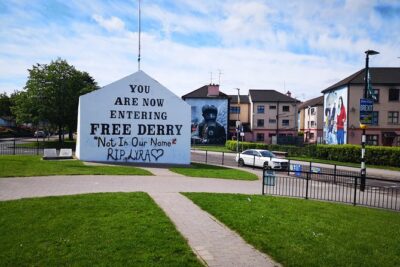
Belfast Political Tour-Conflicting Stories Walking Tour
Read our review →Browse the lists this tour appears in