
Reviewed · BLACK TAXI TOURS
Official World Famous Belfast Taxi Tour ™
The walls still divide Belfast. This private taxi tour makes the city’s recent past tangible, taking you from Bobby Sands murals to Loyalist memorial gardens while local guides explain how The Troubles shaped daily life. I like the chance to step out for close-up photos, and I like that you visit both Republican and Loyalist neighborhoods rather than hearing only one side. The main drawback is the heavy subject matter, with some memorials and stories unsuitable for young children.
A local guide can add what a textbook cannot: personal memories, family connections, and the small details of streets that once made international headlines. Guides such as Paula, Barry, Billy, Neil, Joe, Lorraine, and Chris have been praised for clear explanations, warmth, humor, and willingness to answer difficult questions. The pace can feel brisk, though, especially at the Peace Wall, where some people will want more than the allotted few minutes.
In This Review
- Key points to know before you book
- Why this Belfast taxi tour matters
- From Bobby Sands to the International Wall
- The Peace Wall and Cupar Way
- Clonard Monastery and the no-man’s-land story
- Shankill Road and Loyalist Belfast
- Divis Street, St Peter’s Cathedral, and the IRA heartland
- Divis Tower, the Welcome Wall, and the final view
- What the guides add
- Timing, transport, and pickup details
- Is the $90.98 price good value?
- Who should take this tour?
- Should you book the Official World Famous Belfast Taxi Tour?
- FAQ
- How long does the Official World Famous Belfast Taxi Tour last?
- Where does the tour start?
- Does the tour return to the starting point?
- Is hotel pickup included?
- Is cruise ship pickup included?
- What areas of Belfast does the tour visit?
- Can I photograph the murals and Peace Walls?
- Can I write on the Peace Wall?
- Is this a private tour?
- Is the tour offered in English?
- What is included in the price?
- What is not included?
- Can children take the tour?
- What is the cancellation policy?
Key points to know before you book
- Private access to both sides of Belfast’s divide: See Republican areas around Falls Road and Divis Street, then Loyalist murals and memorials along Shankill Road.
- Personal accounts of The Troubles: Local guides who grew up in Belfast explain the conflict through lived experience as well as historical context.
- Plenty of photo stops: You can get out at major murals, gardens, and Peace Wall sites instead of viewing everything through a taxi window.
- A compact two-hour introduction: The tour lasts about 1 hour 30 minutes to 2 hours, making it useful early in a Belfast visit.
- Hotel pickup has limits: Free pickup and drop-off are offered at Leonardo Hotel Belfast, while other central locations and cruise transfers cost extra.
- A serious, adult-focused experience: The stories include killings, hunger strikes, paramilitary groups, and civilian casualties.
Why this Belfast taxi tour matters
Belfast’s political murals are not simply colorful backdrops. They act as public history books, memorials, political statements, and markers of identity. The neighborhoods you visit still carry the memory of violence, segregation, imprisonment, and loss.
I like this tour because it does not treat Belfast as a collection of isolated sights. The taxi connects the murals to the roads, walls, churches, memorial gardens, and communities around them. You see how close the different neighborhoods are, yet also how sharply they were separated.
The private format helps. Your group travels in an air-conditioned vehicle, and only your party participates. You can ask direct questions without worrying about holding up a large coach group. The driver also handles the route, allowing you to focus on the stories and street scenes.
The experience is not designed as a general city tour. It focuses on the conflict known as The Troubles and its continuing impact. You will see little of Belfast’s broader sightseeing menu, such as the Titanic Quarter or major civic attractions, unless they happen to be part of your transfer arrangement. Book this for political history and local perspective, not for a broad overview of every part of the city.
Other black taxi tours in Belfast:
- Belfast: Political Taxi Tour
★ 4.8 · 5,014 reviews - Cab Tours Belfast Famous Black Taxi Tours
★ 5.0 · 3,633 reviews - Private Black Taxi Belfast City Tour
★ 5.0 · 2,188 reviews
From Bobby Sands to the International Wall
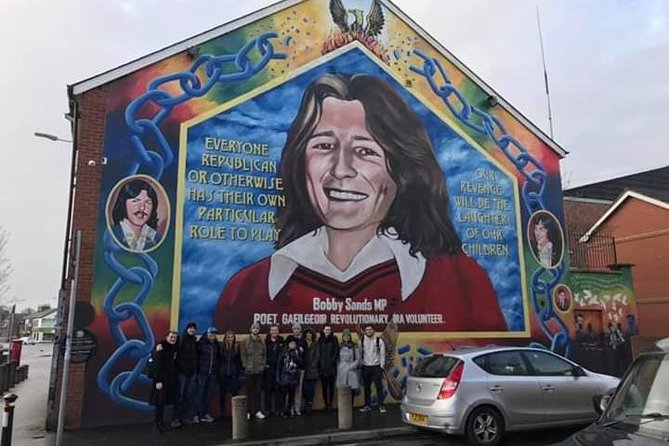
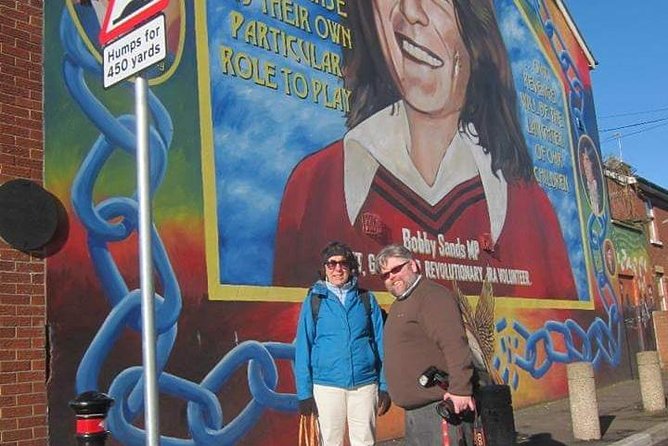
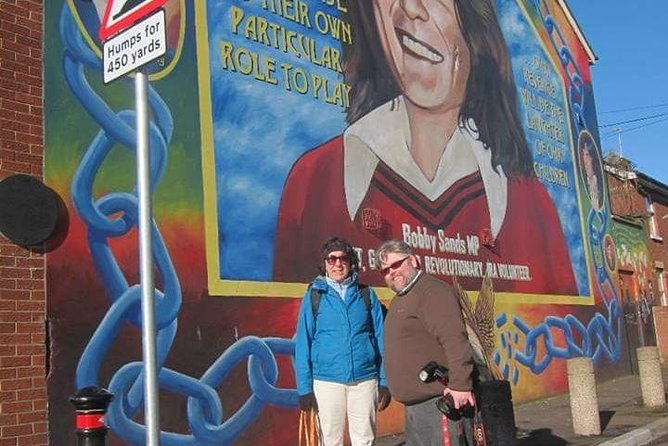
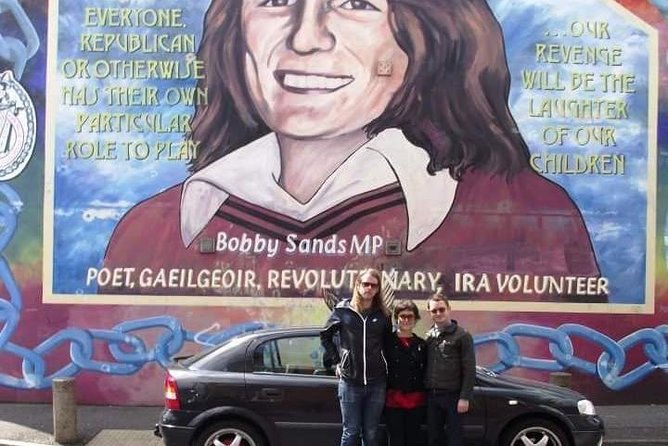
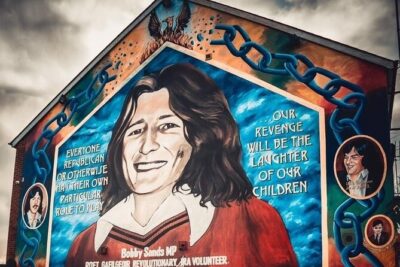
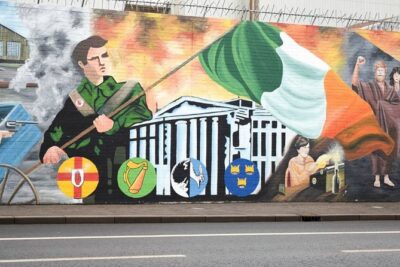
The tour begins with Belfast’s famous Republican murals, including the Bobby Sands mural and the International Wall around Divis Street. Bobby Sands became a central figure in the 1981 IRA hunger strike, and his image remains one of Belfast’s most recognizable political symbols.
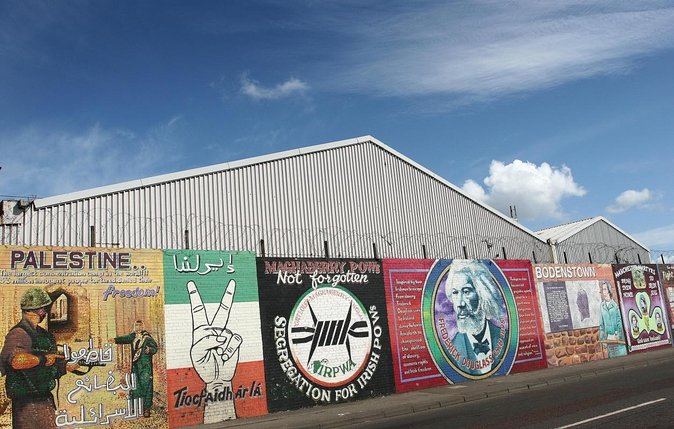
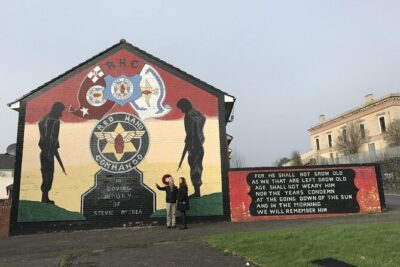
Your guide explains how murals developed in Republican and Loyalist communities. Republican murals often refer to the 1981 hunger strike, international revolutionary movements, civilian deaths, or particular events such as the Ballymurphy Massacre and McGurk’s Bar bombing. The point is not just to identify the people in the paintings. It is to understand why a wall became a place for remembrance and political expression.
The International Wall also includes messages of solidarity and political art from beyond Northern Ireland. You can get out for photographs and inspect the work at street level. That matters because the scale and detail of these murals are easy to miss from a moving vehicle.
Expect the guide to give the history in plain language, but do not expect every political question to have a simple answer. The tour deals with competing identities: Irish nationalist and British unionist, Catholic and Protestant, Republican and Loyalist. A strong guide helps you understand those terms without turning the trip into a partisan speech.
The Peace Wall and Cupar Way
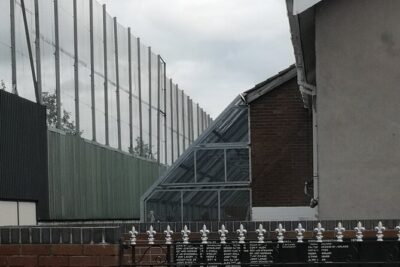
The Peace Wall is one of the tour’s clearest reminders that the conflict has not vanished from Belfast’s physical layout. These barriers separate predominantly Republican and Nationalist Catholic neighborhoods from predominantly Loyalist and Unionist Protestant areas.
Some peace lines are made of brick, iron, or steel and reach up to 25 feet high. Gates in some walls may allow daytime movement but close at night. The Cupar Way section gives you a close look at how a temporary security measure became part of the city’s permanent visual identity.
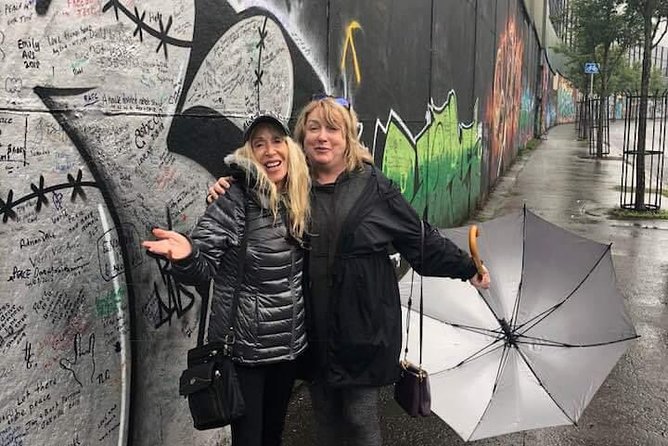
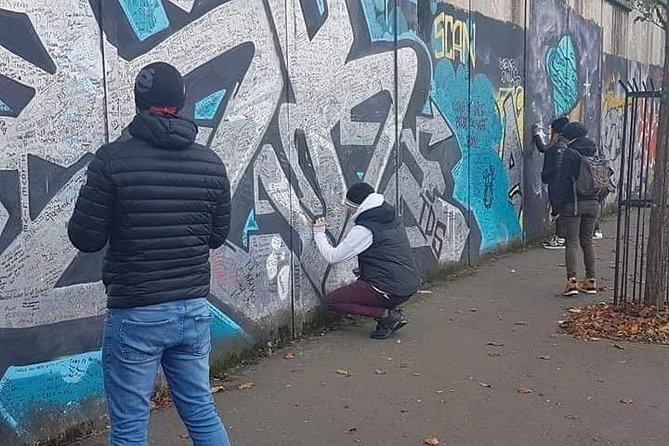
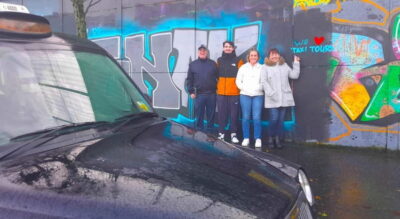
You can write your name or a message of hope on the wall. The site has also attracted signatures from people including Bill Clinton and the Dalai Lama. It is a small, personal act, but it can feel oddly powerful in a place built to keep communities apart.
The tour allows about five to ten minutes at the Peace Wall stops. That is enough for photographs and a short explanation, but it may not satisfy you if you want a long, quiet visit. One useful tip is to decide in advance if you prefer pictures, questions, or writing a message, since time moves quickly.
Clonard Monastery and the no-man’s-land story
Clonard Monastery adds a different layer to the route. The monastery sits near an interface between communities, a location described during the tour as being in the middle of no-man’s-land.
The building itself offers a calmer visual contrast to the murals and security walls. Yet its position is the point. Sacred buildings, homes, pubs, schools, and ordinary streets could all be caught up in the conflict because the dividing line ran through lived-in neighborhoods.
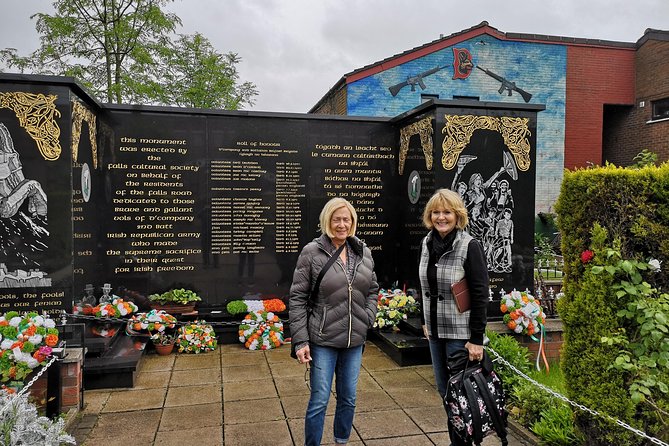
You also visit the Clonard Martyrs Memorial Garden on Bombay Street. The garden commemorates fallen volunteers from IRA C Company, civilian casualties from the Greater Clonard area, and Republican prisoners who died between 1916 and 1970. Plaques also remember Republican prisoners from the area who died after the garden was opened.
This is one of the more solemn stops. The memorial presents a Republican account of loss, so your guide’s explanation matters. You should listen for context rather than treating the site as a complete account of the conflict. The value of visiting both communities later in the tour is that you see how each side remembers its dead.
More Belfast outings booked on the same trip:
- Belfast: The Titanic Experience with SS Nomadic Visit
★ 4.7 · 7,163 reviews - From Belfast: Giant’s Causeway and Game of Thrones Day Tour
★ 4.4 · 7,061 reviews - From Belfast: Giant’s Causeway Full-Day Guided Trip
★ 4.8 · 6,361 reviews - Titanic Belfast Entrance Ticket: Titanic Visitor Experience Including SS Nomadic
★ 4.5 · 3,698 reviews
Shankill Road and Loyalist Belfast
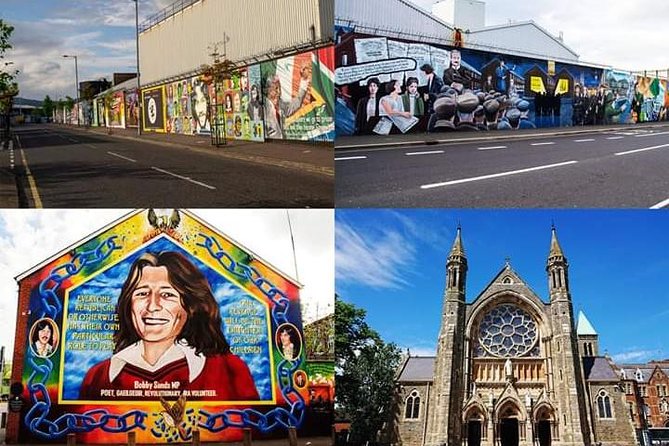
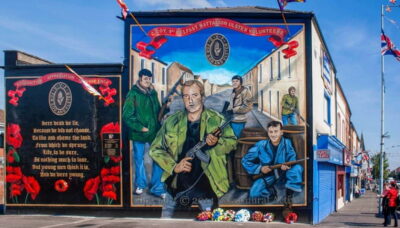
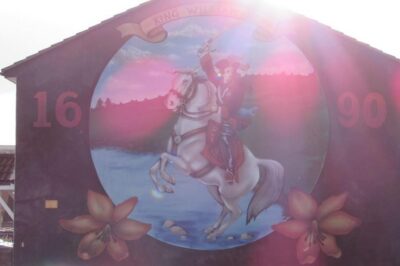
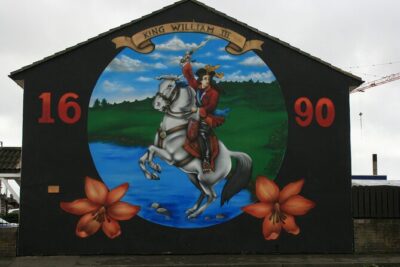
The route then crosses into the Loyalist area around Shankill Road. Here you see murals linked to the Ulster Defence Association and Ulster Volunteer Force, along with images of King William of Orange, often called King Billy, and references to the Battle of the Boyne, the Battle of the Somme, and the 36th Ulster Division.
These murals express British identity and loyalty to the United Kingdom. They also commemorate deceased members of Loyalist paramilitary groups. Again, the paintings are not neutral decoration. They tell you what a community has chosen to remember and protect.
The tour includes the Shankill Road Memorial Garden and the Bayardo Memorial Garden. The Bayardo site recalls the 13 August 1975 attack on a pub on Aberdeen Street. Four Protestant civilians and one UVF member were killed, and more than fifty people were injured.
That stop can be difficult because it moves from general political symbolism to a specific act of violence and its victims. I appreciate that the route includes it, since the history of The Troubles cannot be reduced to famous leaders and murals. Ordinary people were killed in pubs, homes, streets, and workplaces.
Divis Street, St Peter’s Cathedral, and the IRA heartland
Back on the Republican side, the tour passes the International Mural Wall on Divis Street and St Peter’s Cathedral. The cathedral is the Roman Catholic cathedral for the Diocese of Down and Connor, and its construction began in the 1860s.
St Peter’s provides useful religious and civic context, but this is not primarily a church tour. The surrounding Divis Street area is tied closely to Republican history, and the guide uses the neighborhood to explain how the conflict shaped local identity.
You may also see armed Loyalist murals at 56 Sherbrook Close, then return to additional Bobby Sands murals. The repetition is intentional. Sands’ image appears in several places because he became a major symbol of Republican memory, especially after the 1981 hunger strike.
The route also includes a Republican Garden of Remembrance associated with IRA Belfast Brigade D Company. As with the Clonard garden, this is a memorial space presenting one community’s experience. The tour’s strength is that it places these sites beside Loyalist memorials rather than asking you to understand either side in isolation.
Divis Tower, the Welcome Wall, and the final view
Near the end, you see the Welcome Wall and Divis Tower, an important landmark in the Republican area. The tour explains that the British Army used a sniper’s nest in the tower, giving the site a stark connection to the security presence during The Troubles.
The stop helps you see how military infrastructure became part of the neighborhood’s daily view. A tower, wall, gate, or checkpoint was not background scenery for people living there. It shaped movement, fear, and local memory.
The schedule includes many short stops of about five to ten minutes. That keeps the tour moving and lets you cover a wide section of Belfast in a limited time. The trade-off is that you will rarely have long to wander, reflect, or study every mural in detail.
What the guides add
The best part of this experience is the human explanation. Paula has been praised for combining personal memories with clear historical background, while Barry is known for an energetic style, charm, and strong command of Belfast’s past. Billy has spoken about growing up during The Troubles, and Neil has been noted for accommodating questions and stopping when needed.
That personal connection can make the tour more direct than a museum display. Guides explain what it was like to grow up in a city where communities were divided by identity and security barriers. They also add humor and everyday cultural details, which can give the serious history some breathing room.
The tour aims to show both sides without pretending that every issue is settled. You should still ask questions respectfully. The subject includes paramilitary violence, civilian deaths, imprisonment, hunger strikes, religion, national identity, and political allegiance.
One practical point: guide assignments are not guaranteed. You may be led by Paula, Barry, Billy, Neil, Lorraine, Joe, Chris, or another local guide. The guide you receive will shape the tone and amount of personal detail, though the route is built around the same major themes.
Timing, transport, and pickup details
The tour runs about 1 hour 30 minutes to 2 hours. Start times are offered from 8 a.m. through 5 p.m., with several hourly options. A morning departure can work well if you want historical context before exploring Belfast independently, while an afternoon tour may fit better around other plans.
Free pickup and drop-off are available at the Leonardo Hotel Belfast in the city center. Belfast city-center hotel or Airbnb pickup may be available if requested, but an extra charge can apply. Pickup or drop-off at the Titanic Museum, Crumlin Road Gaol, Lanyon Train Station, Queen’s University, Botanic Gardens, Ulster Museum, or St George’s also costs extra.
Cruise ship pickup costs an additional £25, and the return trip costs another £25, paid directly to the guide. If you are arriving by ship, confirm the arrangement and payment method before setting out. The advertised meeting point is the Leonardo Hotel Belfast, and the activity returns there unless another arrangement is made.
The vehicle is private and air-conditioned, but the exact group capacity is not stated. A Mercedes-Benz V-Class upgrade may be available for £20, but it is not guaranteed. Since the route involves getting out at walls and memorials, wear comfortable shoes and bring rain protection. Belfast weather can change quickly, and several stops are outdoors.
Is the $90.98 price good value?
At $90.98 per person, the cost is easier to justify for a small private group than for one or two people. You are paying for private transport, hotel convenience, a focused route, and a guide who can answer questions as you go. A larger group can also benefit from the private format because the price buys a shared experience rather than separate seats on a large coach.
The value is strongest if you have limited time in Belfast or do not feel comfortable finding these neighborhoods on your own. The driver handles navigation, and you can see both sides of the city’s divide without piecing together several separate visits.
The value is weaker if you mainly want a long mural photography session. Stops are short, and the route covers many sites. You will gain breadth and explanation, but not unlimited time at each wall.
The tour is often booked well ahead, with an average booking lead time of about 36 days. If your Belfast dates are fixed, reserving early is sensible. Free cancellation is available up to 24 hours before the start time, but changes or cancellations inside that window are not refunded.
Who should take this tour?
I would recommend it to adults interested in modern political history, social divisions, local memory, and the way conflict shapes streets. It also suits first-time visitors who want a strong introduction before exploring Belfast on foot.
Families can take it, but use judgment. The material includes graphic and upsetting events, and some displays may be too intense for children. Older teenagers who already understand the subject may find it meaningful, but the tour is not light entertainment.
This is also a good choice for cruise passengers, provided you budget for the separate pickup and return charges. The route gives you a concentrated look at Belfast during a limited port visit.
I would choose another experience if your main goal is the Titanic Belfast museum, city-center architecture, or a relaxed sightseeing loop. Those places are not the focus here.
Should you book the Official World Famous Belfast Taxi Tour?
Book it if you want Belfast explained by someone from Belfast, with direct access to the Falls Road, Shankill Road, murals, memorial gardens, and Peace Walls. I especially like that the tour visits both Republican and Loyalist areas, gives you time to step out, and leaves room for questions.
Go in ready for difficult material, not a polished feel-good outing. If you want more time at the Peace Wall, tell your guide early and be aware that the packed route may limit lingering. For a serious, personal introduction to the city’s divided past, the private taxi format offers strong value, particularly for a small group sharing the cost.
FAQ
How long does the Official World Famous Belfast Taxi Tour last?
The tour lasts approximately 1 hour 30 minutes to 2 hours.
Where does the tour start?
The listed meeting point is Leonardo Hotel Belfast, Great Victoria Street, Belfast BT1 6DY.
Does the tour return to the starting point?
Yes. The activity ends back at the meeting point unless a separate pickup or drop-off arrangement has been made.
Is hotel pickup included?
Free pickup and drop-off are offered at Leonardo Hotel Belfast. Belfast city-center hotel or Airbnb pickup may be available on request, with an extra charge in some cases.
Is cruise ship pickup included?
No. Cruise ship pickup costs an additional £25, and drop-off costs another £25. These charges are paid directly to the tour guide.
What areas of Belfast does the tour visit?
The route includes Republican areas around Falls Road, Divis Street, Clonard, and Cupar Way, as well as Loyalist areas around Shankill Road and related memorial sites.
Can I photograph the murals and Peace Walls?
Yes. The tour includes photo opportunities at the murals, Peace Walls, memorial gardens, and other stops.
Can I write on the Peace Wall?
Yes. You can write your name and a message of hope on the Peace Wall.
Is this a private tour?
Yes. Only your group participates in the private activity.
Is the tour offered in English?
Yes. The tour is offered in English.
What is included in the price?
The tour includes private transportation, an air-conditioned vehicle, the guided route, views of the political murals and Peace Walls, and free pickup and drop-off at Leonardo Hotel Belfast.
What is not included?
Tips, optional vehicle upgrades, certain pickup and drop-off charges, and cruise ship transfers are not included.
Can children take the tour?
Most people can participate, but the subject matter and some displays may be too graphic for children. Use your judgment based on the child’s age and sensitivity.
What is the cancellation policy?
You can cancel up to 24 hours before the experience start time for a full refund. Cancellations or changes made less than 24 hours before the start time are not accepted for a refund.
Newest reviews from Belfast
- VIP Skip-the Line Titanic Museum and Whiskey Tasting Tour★ 4.8 · 11 reviews
- Private Half Day Winter Magic in the Antrim Glens★ 5.0 · 2 reviews
- Giants Causeway Private Tour★ 5.0 · 3 reviews
- Titanic Eastside Bike Tour★ 5.0 · 9 reviews
- The Single Cask Whiskey Experience★ 5.0 · 6 reviews
- This is Belfast Walking Tours. Our history, our culture.★ 5.0 · 7 reviews
- St Patrick’s Centre & Burial Site + Hillsborough Castle & Gardens★ 5.0 · 2 reviews
- Small Group Giant’s Causeway Day Tour from Belfast★ 5.0 · 11 reviews
Black Taxi Tours, compared.
Browse the lists this tour appears in